
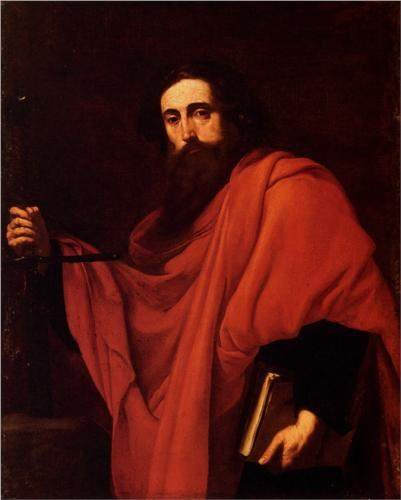
Saint Paul (1637), by Jusepe de Ribera.
[Continuing my thoughts from last night, about the historical reliability of early Christian testimonies, in particular the biblical texts, and the argument that the “orthodoxy” we see today only stemmed from this faction being the victor among many competing early sects. This is Part 2, and it nearly doubled in size from what I started with tonight.]
My friend challenges that the New Testament texts themselves reveal fault lines and factions within early Christianity. Does this argument have merit?
It is true that Paul describes his conflicts with the Judaizers, early Christians who insisted that Jewish Christians should continue to observe the Mosaic Law, in effect, according to Paul, nullifying Christ’s atoning sacrifice by the argument that salvation was only possible through the works of the Law. (See especially Galatians and Romans.) 1 John 4:2–3 seems to reject the doctrines of the Docetists, who argued that Jesus never truly came in the flesh but was instead a kind of divine phantasm. 1 Timothy 6:20 may mark an rejection of early Gnostic thought, which argued that some secret and esoteric knowledge (γνῶσις or gnosis) was necessary for salvation. So yes, there is evidence of some early disagreement; this is not a great surprise, given human free will.
But what was the nature of these disagreements? How widespread were they, and what following did these alternate viewpoints have? We don’t have that information, since these mentions in the New Testament itself are the only sources we have even attesting to their existence at this early date, just as the New Testament documents are the only testimonies we have to the first-century Christian Church.

The Apostle John is traditionally held to have been really old when he died, around the turn of the second century.
Even more important: how early were these disputes? The first epistle of John (1 John) is believed to be one of the latest documents of the New Testament, written as late as the final decade of the first century. By that time, those who had personal experiences of Jesus had nearly all passed away. Paul’s first epistle to Timothy (1 Timothy) is generally believed to have been written toward the end of Paul’s ministry and life, between A.D. 62 and 67, also nearly a generation after Christ. A setting in which the firsthand witnesses to Jesus’s life and ministry were passing from the scene would have been ripe for the rise of new interpretations and viewpoints.
But of course, the rigorous skeptic would ask, how do we know which is the original viewpoint, and which are the alternative ones? In addition to examining the dating of the extant documents — the oldest texts, especially those written mere decades after Christ’s ministry, having at least the greatest authoritative claim — we should examine the authors of these texts, and question their claims to authority. In a similar way, in judging the reliability of ancient historians, we consider who they were and how they would have obtained their information. Thucydides, for example, is generally accepted as a reliable authority on his subject, he being a contemporary and firsthand participant in the Peloponnesian War.

Saint Paul Writing His Epistles (ca. 17th century), by Valentin de Boulogne (1591–1632).
To begin, let us consider Paul, the largest target, he being the author of the greater part of the New Testament. It is reasonable to accept that there was in fact a Christian leader named Paul who wrote a series of letters in the first century. It is also reasonable to accept that at least some of the letters we ascribe to Paul were in fact written by Paul. If this weren’t the case, we would have to ask why this Paul character had such authority if he never wrote anything authoritative. It is reasonable to accept, from the fact that his letters were accepted as authoritative, that Paul’s teaching and influence covered a fairly wide geographic area for the time, with Pauline letters being addressed to Christians in places as diverse as Philippi, Ephesus, Corinth, and Rome. We have no reason to question that Paul actually visited these places and taught those Christians in person: otherwise, no one would have accepted his letters as authoritative. These letters, if authentic, can be reasonably dated to the A.D. 50s and 60s, based on internal evidence.

Or, Shakespeare could have written St. Paul.
Of course, it is conceivable that “Paul” himself could have been an elaborate hoax perpetrated by someone writing in the second or third century, planting and disseminating Pauline letters around the Christian world (by that time vast). Perhaps Paul never existed at all, let alone visited any of the places he is supposed to have visited, and the supposed recipients of his letters never received them at all. ― But this line of reasoning presses “rigorous skepticism” to the point of the ridiculous.

St. Ignatius of Antioch
We know with reasonable certainty that Paul did exist; we know that his letters were disseminated among Christian communities fairly rapidly. Nearly all of the canonical Pauline letters were in circulation and were accepted by Christians by the end of the first century — by the testimony of Ignatius of Antioch, who quoted most of them explicitly in the letters he wrote to Christian communities around Syria and Asia Minor and to Rome. We can draw from Ignatius’s quotations both that he had access to the many New Testament documents he quotes — and probably knew them by memory, since it seems unlikely he would be traveling to his death carrying a full library — and also that the communities to which he was writing would have understood his allusions and their context also, having access to the same documents themselves. Also tellingly, he did not quote or allude to any other documents that were later rejected from the New Testament canon.
So it seems reasonable to conclude that Paul was widely accorded authority by at least some Christians as early as the A.D. 50s and 60s. These Christians were spread over a wide area, to nearly every corner of the world that the Christian message had then advanced — since, at least according to “orthodox” accounts, Paul was the one advancing it. The fact that he was accepted by Christian groups in many places and not by isolated sects is an argument in favor of his authority and reliability as an historical source. Organized, dissenting sects would have had identifiable leaders — just as we know the names of the major proponents of nearly all of the later “heresies.” Here there is no evidence at all of such organized sects during Paul’s lifetime — neither through literature of their own, nor through rigorous opposition that would have been evident in the surviving “orthodox” documents.
[There’s more where that came from! Stay tuned!]
In Paul’s lifetime, I don’t think there was a concept of Christian heresy yet as we would consider it. There were definitely Christians whom Paul disagreed with on some major points, but the church was still in its birthing years and hadn’t quite figured out what it was yet.
On a tangent, what’s your opinion of Paul, pseudo-Paul, and Definitely-Not-Paul as authors of the New Testament letters? Scholarly consensus, tenuous as it is, is that Paul definitely wrote seven of the letters (Romans, 1 & 2 Corinthians, Galatians, Philippians, 1 Thessalonians, Philemon), may have written the others (Ephesians, Colossians, 2 Thessalonians, 1 & 2 Timothy, Titus, with the 3 Ts widely considered to be pseudo-Paul), and definitely did not write Hebrews.
I don’t get the sense reading any of the canonical letters that any are not genuine. They all sound very distinctly Paul. I haven’t read much of the criticism, but what little I’ve read stems from bad (and generally anti-Christian) assumptions. No one in the Church seriously challenged those letters for some 1,800 years. As I said above, nearly all of them are attested to have been circulated and accepted by the end of the first century (see the linked Ignatius post for a list). None of them conflict with any of the other letters doctrinally or espouse anything strange. If somebody was going to bother with a forgery, it would have been for some reason, to promulgate something new they couldn’t by their own authority (I’ll talk more about that in my next post). What is your take?
I agree Paul didn’t write Hebrews, and the text doesn’t identify him as its author (which in itself is un-Pauline). Of the names put forward for its author, I tend to lean towards Barnabas. But of course there’s no solid reason to conclude that and we’ll probably never know for sure in this life.
The only NT letter I’ve ever had any serious doubts about is 2 Peter. But since I’ve been Catholic I have accepted it. The main grounds for challenging it is its stylistic and vocabulary differences from 1 Peter — which I will also deal with in the next post.
I’ve found it fascinating from an academic standpoint. Who the author is doesn’t matter to me theologically–the letters are part of the canon regardless.
What I’ve read and studied is that there are inconsistencies in the Greek. The seven letters that scholars agree are definitely Paul all share similar vocabulary, phrasing, syntax, and theology. For the letters that there is disagreement on, there are two main hypotheses: 1) someone is writing in Paul’s name, or trying to use Paul’s name to bolster the authority of the letter, or 2) Paul wasn’t consistent in his writing. There are sometimes major inconsistencies in the disputed letters that make some scholars and theologians question whether Paul really did write them–there is ample historical evidence apparently for students of teachers writing in their teacher’s names as a way of indicating where their teaching authority comes from.
None of it discredits the letters, though. They each have something valuable to teach.
I agree Ken, it doesn’t really bother me either. (I’ve told by others too that it’s far more obvious in the Greek that the letters seem different than in English.)
But given that all the “disputed” Pauline books were written (if they were written by Paul) at the end of his life, isn’t it likely that a) his style and theology developed and/or b) he had someone else write them who might have put things differently from Paul himself?
I’ve never had an issue with that, and as you point out, many ancient texts are pseudepigraphical without being false. In a similar way, they didn’t have quotations and just seem to have a much looser sense of “literary” or “intellectual” ownership, which makes perfect sense in an overwhelming oral culture.
It’s the same in the Middle Ages. It’s not till the printing press, the scientific revolutions and indeed the beginnings of capitalism, that we start worrying about word-for-word accuracy and intellectual ownership. It’s also at that point, of course, that Sola Scriptura kicks in, having developed out of this very historical criticism. It’s been a mixed blessing, I think!
As I said above, I haven’t read any of the academic literature on this. But each of the Pauline letters makes a show of warmth and personal connection with the churches to which the letters were addressed. If any of them were not written by Paul, they were by someone pretending to be Paul and addressing Paul’s followers, or else someone later forging a Pauline letter and adding personal touches to affect genuineness — not just someone assuming Paul’s name for pseudepigraphical purposes, but someone actually being deceptive. Given Paul’s solicitude and concern about forgeries (2 Thessalonians 2:2, 3:17), I don’t think the former would have happened during his lifetime and would have been revealed as false id it did. Paul’s close associates in the churches would have recognized a phony; its personal touches would have missed the mark, and it would likely not address their concerns very well. The latter, a later forgery, is conceivable — but since it appears nearly all of these letters were received by the end of the first century, it would be very strange for someone to “discover” a “lost” letter of Paul that no one knew about and no one remembered receiving in just the three decades or so since Paul’s death. Also, as I said above, no one would have bothered with a forgery to espouse standard Pauline theology. Since none of the letters stand out as being theologically heterogeneous or espouse anything unusual or un-Pauline, this again seems very unlikely.
I tend to think the truth is probably your second suggestion, Laura: Paul, toward the end of his life, if not throughout his whole career, dictated his letters through a secretary or amanuensis — who actually is given voice in Romans 16:22, and in other places, e.g. Colossians 4:18, is implied, when Paul steps forward to sign his own name. I have read speculation that Paul suffered from very poor eyesight, if not ocular disease. In Galatians 6:11, he points out what large letters he signs his name with. It’s very likely, if an amanuensis was used, that the secretary’s style and vocabulary would have been expressed to one degree or another.
I guess it’s time I read some of the academic criticism. I have kind of been avoiding it…
The letters’ authorship is important to me, because my trust and confidence in the message is fairly wrapped up in my feelings toward the author. I do not like the thought of being deceived. I was never able to accept 2 Peter as having anything valid to say during the year or two I believed it was a forgery.
Excellent Joseph. As far back as Athanasius there was a general belief that Hebrews was not by Paul, but everyone regarded it as associated with him and accepted it. We tend to forget that the early Christians were actually quite sceptical of texts, which is why so often Paul points out where he himself had signed the letters.
What the early Church accepted, so should we – hardly like we know better.
If Hebrews wasn’t by Paul, I tend to think that it was by some close associate of his, possibly Barnabas, to whom Tertullian ascribed it. Pope Benedict gave a general audience on Silas and Barnabas and Apollos that’s worth reading (along with pretty much everything the man has ever written): General Audience of 31 January 2007: Barnabas, Silas (also called Silvanus), and Apollos. (I can’t claim credit for finding it — Jimmy Akin tipped me off to it.)
Thank you for that Joseph. Yes, what matters is that the Church has always accepted it as part of the Apostolic deposit.