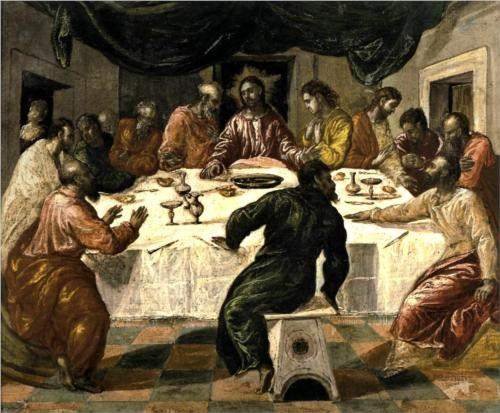
The Last Supper (c.1598), by El Greco. WikiPaintings.org)
The major topic that prompted me to delve into a series on the Sacraments was wondering why Evangelical Protestants* don’t celebrate them. How can a people who profess to base their faith on Scripture alone ignore the very things — in fact, some of the only things — that Jesus told us explicitly to do? Baptism and the Eucharist are the only two of the Seven Sacraments that Evangelical Protestants have preserved in any form — but even these are relegated to the status of marginal, symbolic acts in very many cases. I’ve already written a bit about Evangelicals and Baptism.
Now, in considering the Eucharist, the perfectionist and scholar in me wants to offer a thoroughly researched and documented treatise on the theology of the different Protestant interpretations of the Eucharist, but this topic is now pressing and I thought I would give you instead a few preliminary thoughts. The Wiki provides a decent overview if you like that kind of thing. (And good Lord I had no idea it was this complicated and fragmented and daunting.)
* I am going to start capitalizing “Evangelical Protestant” as a proper noun (even though it’s incorrect! incorrect! by the Chicago Manual of Style) to distinguish Evangelical Protestants, the ones I grew up with and complain about from time to time, from other kinds of Protestants to whom my criticisms might not apply, such as Lutherans. I do this for the sake of not confusing or alarming my dear friend.
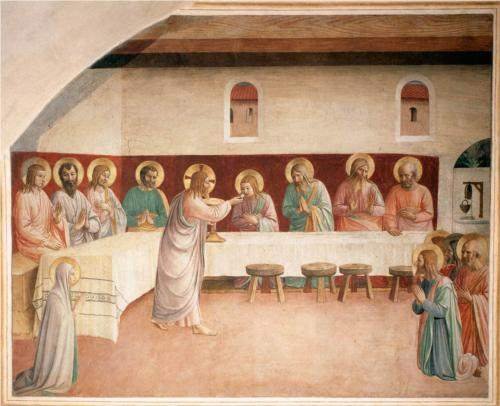
Institution of the Eucharist (1442), by Fra Angelio.
Compared to the rest of His teaching in the Gospels, Jesus gave us few direct, unambiguous commands. Among them are some of the last words he gave us before departing this earth: “Go therefore and make disciples of all nations, baptizing them in the name of the Father and of the Son and of the Holy Spirit” (Mark 28:19) — an explicit imperative to baptize — and His words at the Last Supper: “This is my body, which is given for you. Do this in remembrance of me” (Luke 22:19). One would think that the Apostles and the Early Church would place great emphasis on these things. And in fact they did: they were the very basis of early Christian worship, as St. Justin testifies.
The Witness of the Apostolic Church in Scripture
One would also think that Evangelical Protestants, professing to live and worship by the Word of God in Scripture, would place great emphasis on celebrating these essential Christian sacraments. For coming to faith in Christ is always, as a rule, followed immediately by baptism in Scripture. Likewise for the Eucharist: for it is clear from Scripture that the Apostolic Church celebrated it frequently, if not at every gathering:

Last Supper (1510), by Albrecht Dürer.
They devoted themselves to the apostles’ teaching and the fellowship, to the breaking of bread and the prayers. . . . And day by day, attending the temple together and breaking bread in their homes, they received their food with glad and generous hearts. (Acts 2:42,46)
On the first day of the week [i.e. Sunday, the Lord’s Day], when we were gathered together to break bread, Paul talked with them, intending to depart on the next day, and he prolonged his speech until midnight. (Acts 20:7)
The word translated “as often as” in 1 Corinthians 11:25–26 is simply ἐὰν (eàn), most literally if — if you take the cup, do this — whenever you take the cup — but implying that it is something that will be done. It only makes sense in the context as an implication that it will be done frequently:
“Do this, as often as you drink it, in remembrance of me.” For as often as you eat this bread and drink the cup, you proclaim the Lord’s death until he comes. (1 Corinthians 11:25–26)
Most crucially, Jesus tells us that He is the Bread of Life (pun intended):
“I am the bread of life; whoever comes to me shall not hunger, and whoever believes in me shall never thirst . . . . Whoever feeds on my flesh and drinks my blood has eternal life, and I will raise him up on the last day. For my flesh is true food, and my blood is true drink. Whoever feeds on my flesh and drinks my blood abides in me, and I in him.” (John 6:35,55–56)
The gyrations to which Evangelical commentators must go in order to evade a sacramental interpretation of Baptism and the Eucharist in these passages is rather uncomfortable to see.
The Reality in Many Evangelical Churches
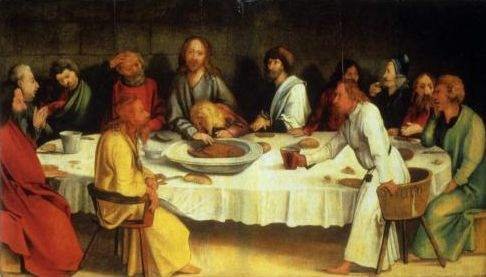
The Last Supper (Coburg Panel) (c.1500), by Matthias Grünewald. (WikiPaintings.org)
But as my new Protestant friends have just recently attested, and as I myself saw in my wanderings, many Evangelical churches seldom celebrate the Eucharist at all — as infrequently as once a month or even once a quarter. Some have even dispensed with it altogether. It blows my mind how the celebration that Scripture plainly indicates was the central act of early Christian worship can have become so irrelevant, to people claiming to follow in the same tradition — how far down and far away the acorn has fallen.
I struggle to understand it. I would be happy if the leadership of one of these churches stopped by and explained the reasoning. But the very idea of dispensing with the Eucharist must rest on the assumption that Baptism and the Eucharist aren’t sacraments at all, but merely symbols or “ordinances.” This idea certainly wasn’t present in the theology of the better-known and revered Protestant Reformers such as Luther and Calvin, who both fully affirmed the sacramentality of Baptism and the Eucharist, and the Presence (however that Presence is understood) of Christ in the Eucharist. It was Huldrych Zwingli who first rejected the idea of the Sacraments, though it’s unclear to me (as yet) how this idea made it into modern Evangelicalism, which largely flowed out of the Second Great Awakening. The rejection of sacramentality seems to have followed in the death of any sense of the sacred at all.
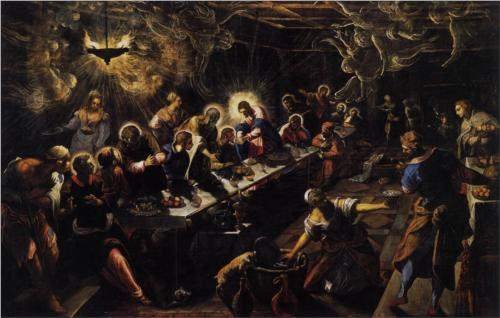
The Last Supper (1594), by Tintoretto.
These modern Evangelicals want to avoid any suggestion of doing something “religious” or “liturgical” or “ritualistic” or — God forbid — Catholic. The idea of “sacraments,” in the Evangelical mindset, suggests that some “works” other than mere belief in Christ is necessary for salvation. The notion that “faith alone” saves, taken in this sense, rejects any idea of sacramentality before it can even begin. If we assume from the get-go that nothing else is necessary for salvation — something Scripture never shows — then any other idea, even if plainly stated in Scripture, is short-circuited.
These churches make a token of practicing Baptism and the Eucharist occasionally, just because they are plainly commanded by Christ. But they have no real meaning or efficacy. If something is merely symbolic, it must be unimportant and unnecessary. It becomes a mere “symbolic act of obedience” — read, “We do this just because He said to do it.” If it doesn’t do anything — if it in itself isn’t necessary for salvation, and doesn’t further the Kingdom of God — then why should we bother doing it? I often get the feeling that these churches feel that the Eucharist is merely gets in the way of the more important work of the church, preaching and teaching and evangelizing.
Not that those things aren’t important. For how are the lost to hear the Gospel without a preacher (Romans 10:14)? But the Early Church, and the Church throughout history, has understood that, as St. Paul says, the Bread and the Cup are a participation — a communion — in the Body of Christ (1 Corinthians 10:16). Through the eating of His Body and the drinking of His Blood, we abide in Him and He in us (John 6:56). It is a “remembrance,” but it is a remembrance in the same way the Passover was a remembrance of the Old Covenant: a re-presentation, “as often as you take it,” of the salvific sacrifice of Christ, our Passover Lamb — the New Covenant that saves us and sets us free. How can anyone shuffle that off as merely a quarterly “symbolic act of obedience”?
I am an evangelical christian, and I do agree with the points you have raised that we do tend to celebrate eucharist/communion as a ‘by the way, lets get this over with’ event, which is very sad. I think it is equally sad when we end up celebrating it without our minds and hearts being focused on the sacrifice that Jesus Christ gave of Himself on the cross. And it is even sadder, when, having partaken of the body and blood of Christ, we go out and live lives that dishonor God and seek glory for ourselves. As children of the Most High God, bought by the precious blood of Christ, may each one of us allow the resurrectiion power of Christ work in us and through us, to transform us and the people around us.
Thanks for the comment! I initially had a line in my post about feeling like some thought the Eucharist was a “nuisance,” but I decided that was too mean-spirited and removed it — but maybe some people really do think that way. As I commented above there are even some Catholic (if not the majority of Catholics) who take it for granted and don’t truly reflect on Christ’s sacrifice. We are not supposed to receive if we are in mortal sin or have been away from Mass and Confession for a while — taking to heart what Paul said (1 Cor 11:27–32) — but I’m afraid many “cultural Catholics” do. I do believe that Christ is really there in the Sacrament whether we have faith in it or not — but those who don’t truly embrace Him may close themselves off from receiving His grace. I can testify to that overwhelming and transforming Resurrection power.
So,here’s my question: even granting that the concept of transubstantiation had a literal meaning,since Christ already lives in the hearts of ALL authentic Christians anyway(Romans chapter 8),what is its point? I think the Epistle to the Hebrews nullifies the roman catholic concept of what Jesus meant in John 6…comment?
Welcome back, Laurence, and thanks for the comment. God bless you!
What is the point … of what? Of the Eucharist? Well, for one thing, Jesus taught us to “Do this in remembrance of [Him]” (Luke 22:19), and it’s clear that doing so on a regular basis was especially important to the Church from day one (cf. Acts 2:42,46). Jesus called Himself the Bread of Life, comparing Himself to the manna given to the Israelites in the desert, as you well know — a life-giving and saving spiritual food, that, if we partake of it, we might live forever (John 6:51). He is the Passover Lamb (1 Corinthians 5:7), and His is the blood of the New Covenant, for the forgiveness of our sins (Matthew 26:28). That is “the point.” Perhaps I’m not understanding what you’re asking?
I don’t really see, either, how Romans 8 relates to what you are saying. The indwelling of the Holy Spirit and the gift of the Lord in the Eucharist are two entirely different, unrelated graces, and having one doesn’t render the other irrelevant.
And no, obviously, I disagree with your interpretation of Hebrews. 🙂 I’ve read and studied the Protestant argument many times. It is usually based on a fundamental (sometimes willful) misunderstanding of what Catholics actually believe and claim about the Eucharist and the Mass.
A sidenote: The Real Presence of Christ in the Eucharist is a belief the Church has held since the beginning. Transubstantiation is St. Thomas Aquinas’s scholastic explanation of the Real Presence, but the two terms are not the same thing. The Church’s belief in the Real Presence stands on Scripture alone, and does not stand or fall by “transubstantiation.”
The peace of the Lord be with you!
No…I’m afraid that you misunderstood me,Mr.Richardson. (1),the Romans chapter 8 discourse plainly speaks of the Indwelling presence of the Triune God;common sense would suggest that the ingesting of the Body and Blood of Christ as your church describes it is a distinction without a difference,if you hold to that interpretation.John says Jesus proclaimed that those who do not partake of this metaphorical “meal”have “no life in them”; Romans chapter 8 says virtually the same thing however way you try to parse it.Further,if words have any meaning,either Greek or English,eternal life means just that,and the idea propogated by your church that some continuous receiving of the body and blood of Christ is some sort of ongoing necessity is indeed negated by the Epistle to the Hebrews,especially since your church calls it a “sacrifice”; frankly,that undermines your case even more,again per the Epistle to the Hebrews.The primary problem with our perspective ecclesiastical histories and constructs boils down,as always,to Authority and Interpretation.I don’t presume to speak for all denominational hermeneutics,but my studies so far have not convinced me that roman catholicism’s assumed authority and interpretations are something I’m obligated to submit to,no matter how old its claims about itself are.So…that is where I stand,Mr.Richardson.—PEACE IN CHRIST.
Thanks again, Laurence. So what did you mean, “What is the point?” Does your church celebrate the Eucharist (or the Lord’s Supper, or Holy Communion, or what will you)? “What is the point” from your perspective?
Your “common sense” that the indwelling of the Holy Spirit and Communion with the Lord in the Eucharist is “a distinction without a difference” is not a sense that I share. Nor do I share your reading of John 6 as a metaphor or of the Epistle to the Hebrews as any way contradictory to my understanding of the Eucharist and the Mass. It is fine and well if you’re not convinced by Catholic claims; I am not pushing those claims on you. His peace be with you!
Man does not live by breath alone. Just as air will not sustain you without food, neither will the Breath of God sustain us without the Bread of Life. Indeed, every believer is indwelt by the Holy Spirit, and where the Holy Spirit is, so is Christ, but recall also that under the Old Law, whoever did not keep the Passover was cut off, though God was in their midst.
A “religious sound-bite” response to be sure, but it must be trashed in the nearest dumpster. The catechism holds the opinion that God uses non-Catholic , Eucharist-rejecting churches as a “means of salvation” (818-819); consequently, He appears to be sustaining them WITHOUT consuming the RC Eucharist, contrary to your contention that He does not.
Hi, Glenn. Thanks for the comment. As you’ve observed, “sound bite” responses are not helpful in a discussion such as this. Yes, certainly the Holy Spirit sustains believers and churches who reject many aspects of their Catholic heritage. The passage in the Catechism (citing Vatican II) acknowledges this. But their sustenance is because of God’s mercy and love, and despite their rebellion, not because of it. The same passage presents that such churches are lacking, and depriving themselves of, many essential gifts of God’s grace. His grace and peace be with you!
This sounds familiar! I think you’re right that it’s just when you strip a sacrament of all power, you get a symbol and the Protestant ethos isn’t too keen on symbols anyway.
I also think the utilitarianism of Protestantism comes out in this way, either in the seeker-friendly attitude that avoids anything even vaguely esoteric or the more traditional attitude that sees church as a training ground for mission. Both are very out-ward focused actually, and that’s a great thing, but it’s why we have the liturgy of the Word and the of the Eucharist, and the historic division between the catechumens and the baptised. We need both.
Looking forward to the rest of the posts! 🙂
Absolutely! It strips away not just the symbolic but any sense of the sacred — any sense that one is in a holy place in church, in which to honor God with our reverence; that people or places or things or activities are sacred, and that God is anyone but our friendly neighbor. God is and can be that kind of intimate, personal God to us, through Jesus — but he is still God, the Creator of the Universe. Where is the awe?
I don’t think it’s a lack of awe as such. In my Calvinistic Anglican world, I remember plenty of awe and reverence for the Lord of the Universe, it just wasn’t expressed as reverence the way Catholics think of it. It was all internal and what you thought and felt and your moral actions, but never in ritual. Was that your experience?
Once, for thrills, I attended World Harvest Church (http://whclife.com) to see what the Megachurch experience was like.
There was no communion that Sunday, and it sounded like there was no set schedule for it. At the end of the service, Rod Parsley announced that communion was going to happen the following Sunday because at 3:00 that morning, the Holy Spirit had woken him up and told him to have communion the following week because “something special was going to happen”.
Reading the church’s website, it is clear that Baptism and Communion are only symbols to that church, and my experience tells me that neither are truly important. Only one thing is important in that church–that an individual must make a conscious act of asking Jesus into their heart. I have never bought this theology, and it goes against everything I grew up with.
I giggled at the asterisk–you begin to understand why Protestant is such a troublesome term!
Oh, I’m well familiar with Rod Parsley and his church. During my little visit to Columbus a few years ago, my mom called them and asked them to pray for me, which I do appreciate.
The internets are abuzz this morning (I guess, have been for a few days) with a story I thought you’d find interesting, if you haven’t already seen it: the suggestion (of suggestions of) a Lutheran ordinariate of the Catholic Church. I’m particularly amused by all the people — from Calvinists to Traditionalist Catholics — whose panties are in a bunch over the statement that there are some for whom “the changes introduced by the Second Vatican Council were an adequate response to Luther’s request for reforms five centuries ago.”
Hmm, an interesting prospect and an interesting article (though I wish the author had taken the time to quickly look up the name of the worldwide Lutheran communion instead of printing the wrong name). Most of the reforms Luther demanded are in fact in place now, whether through the Council of Trent or through Vatican II. And I’m not -too- bothered by the idea of a Lutheran ordinariate. I wouldn’t want to be a part of it, but who’s to say others wouldn’t? It sort of jettisons some key pieces of Lutheran theology though–Lutherans in the ordinariate would have to recognize the Bishop of Rome as the indisputable, infallible, and unilateral head of the church, something that Lutherans have taught against for centuries. It seems like it would just be easier to join the Roman Catholic church than to set up an ordinariate.
I’ve heard of the Lutheran World Federation, but apparently there is also a International Lutheran Federation? Perhaps a federation of more conservative Lutherans? Fr. Z has some reflections on it as a former Lutheran — it was through him that I found the Vatican Insider article. I suspect this will be a big deal for conservative Lutherans as it has been for conservative Anglicans, who are alienated by the liberal shift of many other Anglicans, especially on sexual and gender issues. As somebody I read pointed out — and this is the whole reason for the ordinariate — this would allow whole congregations to come to Rome together. Individuals converting entails leaving their community, and that is often not a good thing.
The body mentioned in the Wisconsin Evangelical Lutheran Synod’s site is actually called the Confessional Evangelical Lutheran Council. It is the smallest of the three international Lutheran bodies and by far the most conservative, like the WELS, with 24 member churches representing a few million members. Next up is the International Lutheran Council, still conservative, but not as conservative as the CELC, with 34 member churches representing roughly 3.5-4 million Lutherans. It is mostly influenced by the Lutheran Church–Missouri Synod.
The largest by far is the Lutheran World Federation, with 143 member churches representing 70 million Lutherans, which is moderate to liberal and which includes my church, the Evangelical Lutheran Church in America. It is this body that the article references, because it mentions General Secretary Martin Junge, who is the GS of the LWF.
Kind of an interesting response from Fr. Zuhlsdorf. He doesn’t seem to have any love for his former tradition. I, too, am curious about what Rome would consider to be “legitimate traditions”. To my knowledge, nothing that Lutherans do on Sunday morning conflicts with Roman Catholic theology except who is welcomed to communion–and even among Lutherans, there are very sharp divides. I can’t imagine something being forbidden, unless it’s allowing Pastors to marry. Obviously, some theological shifts will be necessary to bring the Lutherans in the ordinariate in line with Rome, but maybe you can think of traditions that wouldn’t be allowed anymore.
Fr. Z also has no love for ecumenism, which I find disheartening. He does have a point, though, that the LWF doesn’t govern any members, so Pastor Junge’s opinion is just that, an opinion.
Hey,Mr.Richardson…just read this.The term”panties in a bunch”is an insulting pejorative; I find myself somewhat surprised at such language coming from you,and disappointed as well. Mull and reflect,my friend.
Hmm. Really? You took the time to reply to a passing comment that was over a year old, that was not even addressed to anybody in particular — and you didn’t engage any substantive part of my argument, but only complained about my use of language?
Methinks it must be a slow trolling day in the blogosphere.
Yes I did,sir.If you remember,we went over that issue already,and as far as I’m concerned,I have no interest in re-flogging what to me is a dead horse.I’m content to let Almighty God judge my approach to Communion.As for the post I sent you today,language is often indicative of character;if you are satisfied that such mean-spirited comments reflect how you view those who disagree with your take on things,so be it.As the Scriptures say,”Out of the abundance of the heart the mouth speaks”.Good to know that your heart is filled with contempt and vitriol for those who don’t toe the Catholic party line.—PEACE.
You have no interest — but yet you’re still buzzing around this “dead horse” like a fly? There are more than 300 posts on this blog. I invite you to take a look at some of my other articles. I’m sure you can find something else to pick at that might be amusing for both you and me. I would be interested in your honest opinions.
I don’t know where you are, but where I come from, “panties in a bunch” is a common and casual idiom that could hardly be construed with “contempt and vitriol” even if one tried, or even said with a straight face. It’s a jocular ribbing, again not directed at anyone in particular, either to mock or deride. I think you need to lighten up. I certainly said it lightly, and not with a “mean spirit” toward anyone, let alone you.
May the peace of Christ be with you.
Aren’t you making the assumption that the Christians in attendance were unbaptized? How do you know that? (By the way, I am not a”fan” of Rod Parsley.).I wasn’t aware it was your place to judge the standings of other Christians,or even your business to know.–Mull and reflect,Mr.Ranos.
Hmm, I don’t think Ken assumed that, or made any judgment about the standings or sincerity of those people’s faith. He was merely commenting (in response to my article) on the general lack of emphasis on the Eucharist and even Baptism in many Evangelical churches.
Actually, assuming you aren’t already contemplating it, I’d like to hear your answer to your own question–why do you think that some Protestants don’t celebrate the Eucharist?
That’s what I hoped I considered a little in the post: a rejection of the idea of sacramentality as “works,” leaving them with “ordinances” deprived of any real power or meaning, and therefore any real reason to devote themselves to them. Feeling they have better things to do, like more preaching and teaching and evangelizing. Also, I suspect, a preoccupation with real-life “application” and “relevance” and feeling that “churchy” stuff is unattractive.
In reply to your other comment: That’s nice to know. My other Lutheran friend, a new Christian, for whom the note above was meant, is Missouri Synod.
Yeah, I noted that Fr. Z was rather negative toward the Lutheran tradition, but especially toward the idea of rejecting an ordinariate as “against ecumenism.” As you’ve called me on before, Catholics tend to look down on the “let’s get along” kind of ecumenism in favor of convincing others of the truth of Rome, or seeking real progress in resolving theological differences, even if only on the individual level — but occasionally, as with the Lutherans and the doctrine of justification, on a larger scale. Sometimes, though, the “let’s get along” and “let’s work to understand each other” kind is necessary before one can go the longer mile — especially when many Reformed Protestants reject even that. The idea that it’s better to preserve the weakening unity of a schismatic tradition (it’s true!) than allow people inclined to come back to Rome to do so, is what doesn’t sit well with Catholics. It seems to embrace the idea that “all roads are equally valid,” and we reject that.
“Legitimate traditions” might be liturgy and hymnody, style and externals. There is a fair degree of latitude within the Catholic Church for how things are done (there are a dozen or so different “rites” — the “Eastern Rite” for example, and Byzantine, and Maronite, and now Anglican Use, and a lot more) as long as the right things are done in accord with Rome. I don’t know enough about Lutheran liturgy to really give a specific answer, but if it’s true that “nothing conflicts” externally (there are certainly a few theological issues to iron out, and of course the authority of the pope at the root), then it could be a matter of keeping everything the same but making a few tweaks. Traditions that might need to be dropped, I guess, or modified, might be some of the historic confessions.
Also, Catholics welcome anybody who wants to to come worship with us. We just expect them to understand and affirm our faith before they are allowed into full Eucharistic communion. And we don’t allow anyone who wants to to become priests (not women, not married men [though there are exceptions to that], or people unrepentantly practicing sinful lifestyles — which goes for any sort of sinful lifestyle).
Hi Joseph,
Thanks for the very interesting post. I agree that a great deal of Evangelical Churches have abandoned the ordinance of communion. I would imagine that this is due to the increasing casual seeker friendly approach that many churches have embraced over the past few years.
While I do not agree with the idea that Christ is physically present in the Eucharist, I do appreciate the reverence that the church gives to biblical ordinances. We modern protestants could learn something from this indeed.
I believe that Western Christianity has missed the mark in numerous ways because of the division that was brought about via. Constantine, when he succeeded in driving a wedge between Gentile and Jewish believers.
The early church celebrated communion in light of Passover. The very sacrifice of Christ on the cross was an exact fulfillment of the Passover Seder (the telling). Every year as the Jewish people celebrated the Passover, they foretold of the Lamb of God who would come. Once Jesus was crucified they continued to celebrate the feast as a memorial to His resurrection.
The communion table was originally celebrated as more of a communion meal rather than a ceremony in a church service. While I don’t think anything is wrong in itself with the idea of the church setting, it is unfortunate that communion has for the most part been divorced from its Jewish roots in Western Christianity.
What do you suppose that Constantine did to “drive a wedge between Gentile and Jewish believers”? I’ve not heard this before.
I wouldn’t say that Western Christianity — speaking of the Catholic Church — has been “divorced” from its Jewish roots. (I think Protestantism, in “divorcing” itself from the Catholic Church, is now missing an awful lot.) The Church reads and studies the Old Testament and the Psalms just as ardently as it always has. In fact, the Old Testament underpins everything we believe. We teach that Jesus is our Passover Lamb, the fulfillment of the Old Covenant and of all the prophecy and Scripture in the Old Testament. Just because we aren’t all wearing yarmulkes doesn’t mean we’re “divorced” from the Hebraic roots of Christianity.
My mother (not Catholic, quite evangelical) is very big into the “Jewish roots” movement, too. And I do think there is very much of value and interest in studying the Jewish antecedents of our faith and everything we do, to help us understand better what it is we’re doing and better understand God and His love for us. Catholics do that, too; here are a few really excellent books:
(Speaking of Early Christians: I think you’ll find that the Early Church believed unanimously in the Real Presence of Christ in the Eucharist, which was foretold by the Old Testament, and was very well understood by the earliest Jewish Christians.)
But we’re not Jews; we’re Christians. Jesus fulfilled the Old Covenant, and gave us the New Covenant in His blood. He replaces the Old Covenant, which is now obsolete and has passed away (Hebrews 8:13, 2 Corinthians 5:17). The observances of the Old Covenant were but shadows of things to come, but now we have the substance of them in Christ (Colossians 2:16-17, Hebrews 8:2). Studying the Old Covenant is nice and edifying, but we shouldn’t place ourselves under it again! That’s the whole point of Paul’s letters against the Judaizers (Galatians 4:9-10, etc.).
The idea that Constantine was a Christian is pure myth. Constantine was a Mithras worshipper (Roman Sun god) not a Christian. As a result he began to mix the pagan worship of false gods with Christianity. Many pagan practices began to be adopted by the church during this age that has absolutely no foundation in Scripture.
Here is a short list of just some of these unscriptural compromises.
• The names of saints were inscribed on statues of pagan gods.
• Pagan holidays were adapted by the church as opposed to biblical feast days.
• The Sabbath was moved from Saturday to Sunday
• Gentile Christians & Jewish Christians were divided by Constantine, and Jews were forcibly required to abandon traditional biblical feasts and customs for a new gentile version of Christianity. Constantine officially made a division between the Jew and Christian by law.
Constantine absolutely despised Jews, and was instrumental in forcing a division between Gentile and Jewish believers. In my estimation Constantine did more to harm the cause of Christ than perhaps any other person in history. It was through Constantine that the mixture of paganism was introduced into the church of Rome.
Okay. You have quite a few different claims here. Let me take them one at a time.
First, Mithras was not the Roman sun god. The Roman sun god was Phoebus, Helios, or Apollo. Mithraism was a Roman mystery cult that first developed around the first century and was popular among the military. It never had a particularly widespread following among the Roman public at large.
Second, I’ve never heard that Constantine had any particular affinity for Mithraism. He certainly didn’t embrace Mithraism publicly, and you’ll have to cite some documentary evidence to make such a claim. He wasn’t much of a Christian for most of his life — he was only baptized a Christian on his deathbed — but he had a lot of sympathies for Christians. He claimed to have had a vision of the cipher of Christ in the sky (probably the Chi-Rho) at the Battle of the Milvian Bridge, with the words In hoc signo vinces, “in this sign you will conquer.” He had his soldiers emblazon the symbol on his shield, and he won the battle. Soon after he issued the Edict of Milan, which effectively legalized Christianity and ended official persecution by the Roman government. Constantine donated land and built several basilicas for the Christian community in Rome, including the original St. Peter’s, St. Paul outside the Walls, and St. John Lateran. His mother St. Helena was a Christian and made several trips to the Holy Land, where Constantine also built the Church of the Holy Sepulchre on the traditional site of the Crucifixion and Christ’s tomb. He also called together the first Council of Nicaea. … Anyway, no, at least publicly, Constantine was not a Mithraist and was very supportive of Christianity.
Third, the claim that Constantine “began to mix pagan worship and practices with Christianity.” I’ll speak generally and then I’ll address the particulars you cite. You’ll have to support these claims. Constantine was the secular emperor, not the bishop of Rome. You’ll have to provide some evidence of how and when he ever had any direct influence on the Church. Even at the Council of Nicaea, he called the council and then stepped aside as an observer to let the bishops do their work. This is well documented.
You place a lot of emphasis on the claim that certain practices “aren’t in Scripture.” First, I think a lot of them are and you’re just not seeing them. Second, there’s no evidence that anyone in the Early Church ever held the idea of sola scriptura, that every element of faith had to be found explicitly in Scripture. That’s a Protestant doctrine that never gained any currency at all before the time of Luther. Scripture is the Word of God, but it’s not the only thing God said. Jesus Himself was the Incarnate Word, and His teachings to His Apostles, which they passed on as Tradition, are also a source of Christian doctrine. The Bible is not, and never claims to be, a compendium of all Christian belief.
As to “unscriptural compromises”:
Names of saints being inscribed on statues of pagan gods: I’ve never heard that, and I seriously doubt it. Statues of gods were, well, not very saint-like, and wouldn’t be very adaptable. They were usually naked and “heroic,” or else they were massive cult statues chocked full of pagan attributes. Nobody would ever have accepted those statues as representative of real humans, let alone saints. The imagery of Christian worship developed along a different path and very early, long before the time of Constantine. See, for example, the art in the Roman Catacombs and the icons of Eastern Christianity.
Pagan holidays adapted as Christian feasts: Again, there’s no evidence of that. “Easter” in English may be adapted from the name of a pagan festival, but in Latin and Greek the feast of the Resurrection was always called Pascha, Passover (it still is called that in Eastern Christianity), and celebrated according to various reckonings of the Jewish calendar. Christmas, the Feast of the Nativity, is the other one people (usually non-Christians?) like to pick on. But documentary evidence of the Christian celebration of the Nativity on December 25 actually predates any evidence of the Roman Sol Invictus or any other pagan holiday at that time. Anything else?
Let me “flush” this thing before I lose something; I’m typing on my iPad.
The Sabbath moved from Saturday to Sunday: Well, not quite. First of all, though it’s sometimes called the Sabbath, everybody knows that Sunday is not the Jewish Sabbath. The Early Christians — back to the very first generation, the Apostles themselves — celebrated Christian worship on Sunday, which they called “the Lord’s day,” in honor of Christ’s Resurrection, which superseded the Jewish Law. This is in the Bible. To cite just a few verses, and there are more: Acts 20:7: The “first day of the week” is Sunday. 1 Cor 16:1-2: They’re taking a collection on “the first day of the week” because that’s the day they’re getting together “to break bread” anyway. If this were the same day as the Sabbath, Paul would certainly have called it that. Revelation 1:10: When do you suppose “the Lord’s Day” was? As you seem well aware, the earliest Christians were Jews. They would celebrate their Jewish synagogue services on the Sabbath, and then after the sun went down (then Sunday by their reckoning), they would celebrate the Christian mysteries.
Constantine dividing Jewish Christians and Gentile Christians: As I said originally, I’ve never heard this and you’ll have to cite some evidence other than your own assertions. While it’s clear that Constantine didn’t care much for the Jewish religion, Jewish Christians by the fourth century were already pretty well distinct from traditional Jews and were seen, by Constantine, by the Jews, and by everybody else, as Christians, not practitioners of Judaism. As for the law: Jews had the same protections under the Edict of Milan that Christians did.
Again your claim about “a mixture of paganism and Christianity in the Church of Rome”: this is a very common anti-Catholic claim, but can you support it? What practices do you suppose were “pagan” in origin?
Hi Joseph,
I’m sorry for the late reply (hope the blog is still active). I just wanted to add my opinion on this.
I am a follower of the Eastern Orthodox church (thou not that active, as I pretty much despise the Clergy here because of their corruption and unchristian thirst for power and wealth, but that’s another discussion). I’m not a purist, I believe “we” had some issues wrong (regarding the Papacy for instance) and “you” had some issues wrong (the “Filioque” debate), but this, as well, is besides the point.
I wanted to point out some aspects of religious syncretism that happened here (I’m from Romania) as well as in other places during the early days of Christianity. As you may know, there are some celebration dates that do not math between Catholicism and Orthodoxy. For example, you celebrate All Saints Day on the 1st of November, while we celebrate it on the first Sunday after Pentecost (we even call it the Passover of the Dead, in rough translation). It’s very hard to find out why the Orthodox church chose this date, some speculate that it has something to do with their Resurrection at the end of days. On the other hand, it is also speculated that the Catholic church chose the date of the 1st of November to coincide with Samhain, one of the biggest Celtic celebrations (or it could be any other pagan celebration, as it sits right between the solstice and the equinox). Also, we celebrate the St Michael on the 8th of November (along with the Archangel Gabriel), though I cannot find any reason why (but one can speculate that 30 of September is quite close to the autumnal equinox).
An interesting example is St Andrew’s day, which is our patron saint (it is claimed that he is the first to Christen some areas of our country). It is celebrated worldwide on the 30th of November, but that was a major pre-Christian celebration in our region. Even now, the night of St. Andrew (also known as the Night of the Wolf, the sacred animal of our ancestors) holds mystical significance, as one must perform some actions/rituals in order to protect the homestead from evil spirits (with no Christian element whatsoever, for instance, protection from “strigoi” – our vampires – through garlic, if you ever wondered where that came from). And there are some other ancestral traditions that are blatantly converted to Christian ones (they maintain their old name, but the Church gives them Christian meaning and celebrates some “local” saints and martyrs).
I can definitely see why the Romans would use syncretism to spread Christianity, as it was much easier to covert the population to the “new” religion. They were already celebrating on that particular day, so just “update” the reason. And I do believe that this is why Christmas was set on the 25th of December, as it was one of the most important pagan holiday throughout the Roman empire. But we will never know for sure.
Hi Dan. Thanks for the comment. This blog has been inactive for a while but I am trying to dust it off again.
There is a lot of talk in the U.S., too, from time to time, about the supposed syncretism in certain traditional Catholic holidays — well, pretty much all of them. Some “Restorationist” Christians even reject the celebration of holidays altogether. Easter (which is Pascha everywhere but in countries speaking Germanic languages) is an especially popular bugbear, since it’s alleged the name “Easter” is somehow related to “Ishtar” — there’s no relation at all — or to an Anglo-Saxon pagan goddess named Eostre — could be; there’s no surviving record of such a goddess; all we know, from the Anglo-Saxon Christian writer Bede, is that the month and season was named that.
But to me, incorporating names and even dates from the surrounding culture is not all that important, and does not equate to “syncretism.” Syncretism is putting a pagan idol in your Christian church and worshipping it along with the Christian God, or incorporating beliefs such as reincarnation or karma into your Christian doctrine. It’s possible that, in the popular culture, what we call “Easter” was named, by Christians, after a pagan goddess (or rather, after a month named after a pagan goddess). But the actual, religious, liturgical celebration is not even called “Easter”; it’s called the Solemnity of the Resurrection of the Lord. Yes, there are Easter bunnies and other happy pagan fertility symbols running all around at that time of year. But the actual, liturgical celebration is centered solely on the Lord’s Resurrection. There’s no actual syncretism there. Regarding, for example, the celebration of All Saints. Maybe the timing is related to Samhain; maybe not. Religious celebrations — of all religions — tend to be grouped around the spring equinox and winter solstice, and have nothing to do with one another other than people’s ability to observe the sun and moon and changing of seasons. But even if Christians decided to co-opt the date of a pagan festival — what’s the big deal in that? To a Christian not celebrating the pagan festival, it’s just a date on a calendar. Incorporating pagan beliefs and rituals into your own Christian celebration — that’s syncretism. Adopting the date in order to give your pagan neighbor something better to do on that day — that’s just clever marketing.
The peace of the Lord be with you.
Yeah…the systematic,ongoing persecution of Jewish people by the roman catholic church throughout the centuries certainly attests to the idea that catholics didn’t want to be “divorced” from its supposed Jewish foundation.Yeah,right.
Whether or not the Church has persecuted Jews is irrelevant to whether or not the foundations of the faith are Hebraic.
Don’t try to play coy,Mr.Richardson.Your church’s policies throughout the centuries clearly attest to how the Jews were treated;there is no…”whether or not”…Frankly,attempts to whitewash the heinous, vile, and simply ugly deeds of which your church is guilty will ALWAYS fail,so let’s not go down that road,O.K? PEACE IN CHRIST.
I’m neither “playing coy” nor denying anything; I acknowledge that there have been sins in the past (as does the Church). But it really is completely irrelevant to the question at hand.
By, the way, this happened to come up in my daily reading of the Catechism this morning (I don’t really believe in coincidences):
1096. Jewish liturgy and Christian liturgy. A better knowledge of the Jewish people’s faith and religious life as professed and lived even now can help our better understanding of certain aspects of Christian liturgy. For both Jews and Christians Sacred Scripture is an essential part of their respective liturgies: in the proclamation of the Word of God, the response to this word, prayer of praise and intercession for the living and the dead, invocation of God’s mercy. In its characteristic structure the Liturgy of the Word originates in Jewish prayer. The Liturgy of the Hours and other liturgical texts and formularies, as well as those of our most venerable prayers, including the Lord’s Prayer, have parallels in Jewish prayer. The Eucharistic Prayers also draw their inspiration from the Jewish tradition. The relationship between Jewish liturgy and Christian liturgy, but also their differences in content, are particularly evident in the great feasts of the liturgical year, such as Passover. Christians and Jews both celebrate the Passover. For Jews, it is the Passover of history, tending toward the future; for Christians, it is the Passover fulfilled in the death and Resurrection of Christ, though always in expectation of its definitive consummation.
Oh, and thanks for the comment. I do appreciate it.
Leo the Great in his day says that it was the custom of many Christians to stand on the steps of the church of St. Peter and pay homage to the sun by obeisance and prayers (cf. Euseb. Alexand. in Mai, “Nov. Patr. Bibl.”, 11, 523; Augustine, Enarration on Psalm 10; Leo I, Sermon 26). When such conditions prevailed it is easy to understand that many of the emperors yielded to the delusion that they could unite all their subjects in the adoration of the one sun-god who combined in himself the Father-God of the Christians and the much-worshipped Mithras; thus the empire could be founded anew on unity of religion. Even Constantine, as will be shown farther on, for a time cherished this mistaken belief. It looks almost as though the last persecutions of the Christians were directed more against all irreconcilables and extremists than against the great body of Christians.
Constantine was trying to bring Christianity and sun-god worship together, in order to have what he considered the best of both worlds. This resulted in a mixture of the two religions.
In the dedication of Constantinople in 330 a ceremonial half pagan, half Christian was used. The chariot of the sun-god was set in the market-place, and over its head was placed the Cross of Christ, while the Kyrie Eleison was sung. Shortly before his death Constantine confirmed the privileges of the priests of the ancient gods. Many other actions of his have also the appearance of half-measures, as if he himself had wavered and had always held in reality to some form of syncretistic religion. In other words he was trying to appeal to Christians and pagans, thus mixing the two religions. http://www.newadvent.org/cathen/04295c.htm The Catholic Encyclopedia
While Constantine was noted for favoring Christianity, his rule brought about the marriage of Christian practices with pagan customs. A more orthodox form of Christianity was given birth to that looked very little like the first century church.
Here is another interesting take on the Roman Catholic Church from a Jewish perspective.
The Rape of Torah by PROFESSOR WA LIEBENBERG
The Early Church Fathers, Medieval Period, High Middle Age, East-West Split, Reformation and Counter-Reformation, and Christianity in the Modern Era
Christianity began as a Jewish sect, called the Natsarim (Nazarenes).35 36 The Christian Church traces its history to Y’shua and the Twelve Apostles, and the early dominant Church saw the bishops of the Church as the successors of the Apostles in general. We are speaking here of the Roman Catholic Church. Apostolic Succession is central to the doctrines of the Roman Catholic, Orthodox, and Anglican Churches. They believe that the bishops are the spiritual successors of the original twelve apostles, through the historically-unbroken chain of consecration. They still hold this view to this very day.
From the beginning, Christians were subject to various persecutions. These persecutions often resulted in death for Christians such as Stephen37 and James, the son of Zebedee.38 Larger-scale persecutions followed at the hands of the authorities of the Roman Empire. It began in 64 AD, when, as reported by the Roman historian Tacitus, the Emperor Nero blamed the Christians for that year’s great Fire of Rome.
According to Church tradition, it was under Nero’s persecution that the early Church leaders, Peter and Paul, were martyred in Rome. Further widespread persecutions of the Church occurred under nine subsequent Roman emperors which followed—including Domitian, Decius and Diocletian. From the year 150, Christian teachers began to produce theological and “apologetic” works aimed at defending their faith. These authors are known as the Church Fathers, and the study of them is called Patristics. These Church Fathers include Ignatius of Antioch, Polycarp, Justin Martyr, Irenaeus, Tertullian, Clement of Alexandria and Origen.
All these early Church fathers opposed the Torah-based teachings of the “Jews.” A doctrine was birthed that they were in the “Dispensation of Grace” and that the Torah of the TaNaCh (Old Covenant) is not valid anymore. Furthermore, all the Jewish Books in the Newer Covenant, written years before Paul’s Epistles, were considered not so important and moved to the end, and Books such as Romans and the Epistles written by Paul were moved to the front of the Brit Chadashah. The Roman Church was being birthed and the Letters written to them was regarded as superior. To make things worse, these Letters were also viewed through the eyes of the Roman Christian, and not viewed from a Jewish perspective.
New teachings and thinking patterns were developed and the Jewish Torah-based lifestyle was seen as ‘Old Testament’ and obsolete. To make matters worse, the early Church Fathers regarded Torah as a doctrine straight from the pit of Hell! One of the main reasons for resisting any Jewish doctrine or thinking pattern was because they believed and promoted the idea that the Jews killed Y’shua the Messiah. Jews were seen as part of the “bad guys”.
Christianity was legalized in the Fourth Century when Constantine I issued the Decree of Milan in 313. Constantine was instrumental in the forming of the First Council of Nicaea in 325, which sought to address the Arian39 heresy and formulated the Nicene Creed. The Roman Catholic Church, Eastern Orthodoxy, Anglican Communion, and many Protestant churches 40 still use the Nicene Creed.
In 324, Constantine the Great announced his decision to transform Byzantium into Nova Roma and on May 11, 330, he officially proclaimed the city the new capital of the Roman Empire. The city was renamed
35 Fortescue, Adrian (1912). “Veneration of Images”. Catholic Encyclopedia. Robert Appleton Company. Retrieved on 2007-11-26 36 Acts 7:59 37 Acts 12:2
38 “It is our desire that all the various nations which are subject to our clemency and moderation should continue to the profession of that religion which was delivered to the Romans by the divine Apostle Peter, as it has been preserved by faithful tradition and which is now professed by the Pontiff Damasus and by Peter, Bishop of Alexandria, a man of apostolic holiness. … We authorize the followers of this law to assume the title Catholic Christians; but as for the others, since in our judgment they are foolish madmen, we decree that they shall be branded with the ignominious name of heretics, and shall not presume to give their conventicles the name of churches.” Halsall,
Paul (June 1997). “Theodosian Code XVI.i.2”. Medieval Sourcebook: Banning of Other Religions. Fordham University. Retrieved on 2006-09-19 39 Arianism is the teaching of the Christian theologian Arius (c. AD 250-336), who lived and taught in Alexandria, Egypt, in the early 4th century. The most controversial of his teachings, considered contrary to the Nicene creed and heretical by the Council of Nicaea, dealt with the relationship between God the Father and the person of Jesus, saying that Jesus was not one with the Father, and that He was not fully, although almost, divine in nature. This teaching of Arius conflicted with trinitarian christological positions which were held by the Church (and subsequently maintained by the Roman Catholic Church, the Eastern Orthodox Churches and most Protestant Churches) 40 “The History of the Church”, Howard A. White, http://www.appiusforum.com/restoration.html
Hmmm, a whole new set of claims? What happened to the ones you were going to support before?
As I said and admitted before, Constantine wasn’t much of a Christian (really wasn’t a Christian at all, until his deathbed conversion). The fact that he himself practiced syncretism and “half-measures,” or even that many other Christians in his day did, is no reflection on the truth of Christ’s Church. There are many compromising Christians today, too.
If Constantine’s efforts resulted in a “mixture” of Christianity and sun worship, do you see evidence of sun worship in the Roman Catholic Church today? What about in the Church Fathers? You might peruse the writings of some Fathers who were roughly contemporary with Constantine, such as St. Ambrose (c. A.D. 340–397), St. Jerome (c. A.D. 347–420), or St. Augustine (A.D. 354–430); or some that were later, such as Pope St. Gregory the Great (c. A.D. 540–604). (You can read many of their writings here.) Do you find sun worship? What about in today’s Catechism?
“Orthodox,” you know, means “fixed belief.” So orthodoxy is adherence to the right beliefs of the faith that were set forth in the beginning. If you’re concerned about the orthodoxy of the fourth century being different than the orthodoxy of the first century, you might read the canons of the First Council of Nicaea (A.D. 325), and also some first century writings of the Church: The Didache is instructive, as are the Letter of Clement of Rome to the Corinthians (both of these can be dated as early as A.D. 70, or as late as the A.D. 90s, depending on the scholar), or the letters of Ignatius of Antioch (ca. A.D. 100). These are all considered orthodox writings.
This article you quote from a “Jewish perspective” is pretty scary and frankly possibly heretical. The New Testament is clear as water that the Old Covenant is “obsolete” and has “passed away.” See the verses I already cited to you (Hebrews 8:2,13, and pretty much the whole Letter to the Hebrews; 2 Corinthians 5:17, Colossians 2:16-17, Galatians 4:9-10, and that’s just to begin with). If anyone is seeking to impose Torah on today’s Christians — and Paul is deadly and explicitly clear that it’s through faith, not through the Law (Torah), that we are saved — then they’re falling prey to the early (and apparently still alive) heresy of the Judaizers, which was rejected by the Church at the Council of Jerusalem (Acts 15).
I’ll agree that Constantine was not a Christian nor even a catechumen for most of his reign. He was a pagan who was a fan of Jesus, until a grave illness prompted him to take the Gospel seriously and quit being double-minded. He requested and received baptism on his death bed, lamenting that he could not be baptized in the Jordan River and promising to live a life proper for a Christian if he recovered from his illness. However, I reject as absurd any notion that Constantine introduced any form of paganism into Christianity.
It is evidently clear the Christianity came out of Judaism. The roots of Christianity are clearly Hebrew, and not Western. My point being that when the gentile believers began to outnumber Jewish believers the church began to take on a great deal more gentile style.
Unfortunately many of the early church fathers were actually very anti-Semitic, and began to renounce Jews, and force them to comply with a more Gentile version of Christianity by denying them the right to practice the Feasts of the Lord, and denying them the right to keep the Kosher Torah laws.
The idea that the Old Covenant has been abolished is purely a Western gentile idea that came about as the result of divorcing Christianity from its Jewish roots. Everything Jesus and the apostles taught was straight out of the Old Testament. The law never was intended to save anyone, as it was clearly added over 400 years after the promise of Messiah that God gave to Abraham. (Galatians 3:16-18)
The law was our school master to bring us to Messiah, but this does not mean that we abolish the law. Jesus never said that He came to abolish the law. He said that He came to fulfill it, which actually means to bring it to its logical conclusion. (Matthew 5:16-18)
Paul said that the law was good if it was used for its intended purpose. This simply means that we are not saved by Torah observances, but by the blood of Christ alone. (Rom 7:16, 1 Tim 1:8)
The Western church has basically thrown the baby out with the bath water by divorcing itself from its Hebrew roots. There is so much of Scripture that we will never be able to grasp if we do not see it threw the eyes of a Hebrew because it is not a Western book, it is a Middle Eastern book, and must be approached as such.
The church in the West abandoned the observance of the Feasts of the Lord, which are so rich in prophetic significance, and instead embraced Christmas, and Easter. While I celebrate Christmas with my family, and as a church, I prefer to call Easter by its less offensive name Resurrection Sunday.
It is unfortunate that when someone attempts to bring Christians back to their roots that immediately people imagine that we are preaching legalism. I myself do not observe Kosher Torah laws etc., and worship on Sunday. This is because I am a Gentile, and not a Jew. It is also the fact that I live in a predominant Gentile culture. However I do recognize that a great deal of what the Western church espouses as traditional Christianity is not really what the church looked like in the first century.
I will address the pagan practices later.
Paul said:
Paul, a Jew, says that observances of festivals and new moons are Sabbaths are “shadows of things to come.”
The idea that the Old Covenant has been abolished is a purely biblical idea, spelled out by Paul and the author of the Letter to the Hebrews, both Jewish believers themselves. I do not know any other way to explain it to you other than to show you the Scripture, which I have. If believers, whether Gentile or Jew, want to note the passing of the Jewish feasts, then that’s fine and edifying. But they are not a part of the New Covenant. Yes, the Law was a pedagogue, leading us to the Messiah. But now He has come and we are there. Jesus did bring the Law to its fulfillment. What has passed away are the ordinances about uncleanness, temple worship, and the like. What remains is the New Law which is written on our hearts (Jeremiah 31:33, Romans 2:15) — God’s natural law that transcends the Torah and everything before, as revealed by Jesus Christ.
You will have to show me how any “Church Father” “renounced Jews” or “forced them to comply” with anything, or how any Jewish believer was ever so forced. You continue to throw out these unsupported claims. The fact is, the Jewish people rejected Christ, and they rejected their brother Jews who believed in Christ. Not only did the Church become “more Gentile,” but the Jewish believers within it, rejected by their brethren, in time left behind their heritage. Christ superseded the Torah and made it unnecessary. We are saved through faith, not the Torah. Is it any wonder that the Christian Church, even Jewish believers within it, drifted in time from Jewish cultural observances?
You continue to claim that the Western Church has “divorced” itself from its Hebrew roots. It absolutely has not. I have shown you several times the degree to which we study the Hebrew Scriptures in the light of their prophetic significance and Christ’s fulfillment of them. Every day we have readings from the Old Testament and expositions upon them. Biblical scholars learn the Hebrew language and the Hebrew context of Scripture. In what way is anything being “divorced”?
I say again, if you want to know “what the Church looked like in the first century,” read, above all else, the Bible. Do you find evidence of strict adherence to the Jewish feasts and observances in the writings of Peter, Paul, John, James, or Jude — who were all Jews? Next read the Apostolic Fathers, especially the Didache, St. Clement, and St. Ignatius. Clement, who was the fourth bishop of Rome and lived at the time of Peter, is believed to have been a Jew himself. Where do you find the degree of adherence to Jewish customs that you are espousing? This is “traditional Christianity.”
By the way, my googling just found this book, which goes to the heart of our question. I don’t know this scholar, but the reviews I am reading are good (Mike Aquilina, whom I respect, likes it), and it may be worth a read:
Ignatius of Antioch and the Parting of the Ways: Early Jewish-Christian Relations by Thomas A. Robinson
Here is Mike’s review, which is sturdy.
Thanks Joseph. I will check out some more of these church fathers. I simply disagree with you about the Old Testament. I am not sure we will come eye to eye on this. I hear what you are saying, we are just struggling over some symantics so let’s just leave it at that.
I will read the article you suggested.
Thanks
I would recommend the following book as well http://www.amazon.com/Restoring-Jewishness-Gospel-Message-Christians/dp/1880226669
I’m at a retreat this weekend, and found this book in the bookstore — if you are interested in a Jewish perspective on the Catholic Church:
Honey from the Rock: Sixteen Jews Find the Sweetness of Christ
I appreciate it. I am always interested in hearing things from another perpective. It seems about the timew we think we have a handle on something, something opens an entirely new door.
This one, too, by the same author:
Salvation Is From the Jews
Thanks
As far as I know, one has to partake in the Eucharist with belief in the transubstantion, or else anathema.
“Ecclesial communities derived from the Reformation and separated from the Catholic Church, ‘have not preserved the proper reality of the Eucharistic mystery in its fullness, especially because of the absence of the sacrament of Holy Orders.’ It is for this reason that, for the Catholic Church, Eucharistic intercommunion with these communities is not possible. However these ecclesial communities, ‘when they commemorate the Lord’s death and resurrection in the Holy Supper … profess that it signifies life in communion with Christ and await his coming in glory.’ ” (Catechism of the Catholic Church 1400, quoting from Unitatis Redintegratio [“The Restoration of Unity”], the Second Vatican Council’s Decree on Ecumenism)
To paraphrase: Folks who deny the Real Presence of Christ in the Eucharist, or who otherwise reject the teachings of the Catholic Church, shouldn’t partake of the Eucharist in the Catholic Church. But Jesus said to “do this in memory of Me.” And folks who do that in celebration of Communion with Him and commemoration of His sacrifice for us are doing a good and praiseworthy thing, and we encourage it. Rejecting the Real Presence and the Sacrament of Holy Orders excludes one from communion with the Catholic Church — that’s what “anathema” means, and that’s all it means.
Assuming I’m understanding correctly, you are using the terms ‘transubstantiation’ and ‘real presence’ to mean the same thing. I’ve always understood them to be almost the same, but not quite. The Lutheran tradition is that the ‘real presence’ is the full and real existence of the body and blood of Christ in the bread and wine. It is different from transubstantiation because transubstantiation is built on Greek metaphysics which only allows a thing to have one substance; the bread and body can’t exist together, so the substance of bread is fully replaced by the substance of the body of Christ while retaining the accidents, or appearance, of bread.
Is this an accurate explanation of ‘real presence’ and ‘transubstantiation’ as you understand them?
About holy orders–is the validity of ordination dependent on e ordination being conducted by a bishop in apostolic succession, or are there other factors that also determine its validity?
You’re right that I switched to referring to the Real Presence when the original question referred to transubstantiation — very astute. 😉 I did that because many Protestants, especially Evangelical Protestants, tend to get hung up on the term and concept of “transubstantiation” when what they really have a problem with is the Real Presence at all. I hear more about “transubstantiation” in conversations with Protestants than I’ve ever heard in a Catholic church. You understand transubstantiation and our differences between our doctrines better than I do; I couldn’t have told you the Lutheran position with any clarity. But I presumed (and I probably shouldn’t have) that the commenter (who has commented before) tended toward Evangelicalism. It makes little sense to discuss the very fine, metaphysical distinctions between different conceptions of Christ’s Presence in the Eucharist with a person who rejects the very idea that He is really present there at all.
Transubstantiation is really just a fancy word for the belief that the Bread and Wine actually become the Body and Blood, Soul and Divinity of Christ. (It’s fitting to be having this conversation tonight, actually, since it’s the Feast of Corpus Christi.) When Christ said, “This is My Body,” that’s exactly what he meant. And the Church has believed that the Eucharist really was the Body and Blood of Christ since the very beginning, many centuries before folks in the West were even aware of Aristotelian physics or thought to define it in terms of substances or accidents or call it “transubstantiation.” I have talked to Protestants who thought they could disprove Aristotelian physics and then triumphantly declare that they “disproved” transubstantiation. But no, the Church’s belief in the Real Presence rests on the words of Christ Himself, not on Aristotle. Aristotle just provided the best framework anybody has come up with to explain what the Church has always believed.
The Council of Trent didn’t spend a whole lot of time on the Eucharist or the doctrine of transubstantiation, and it didn’t come up until the thirteenth session. Yes, it rejected the Lutheran idea of the substance of the bread and wine “remaining conjointly” with the substance of the Body and Blood, along with a few other ideas. But the issue is not its rejection of Aristotelian physics, but that the suggestion that something can have more more than one substance — that the Host can be both bread and wine and Body and Blood — doesn’t very well uphold the received truth that “This is [His] Body.” I can understand why the Tridentine Fathers were concerned — any concession on something so fundamental had the potential to open the door to a whole cascade of errors, undermining the whole Sacrament of the Eucharist — but I personally think all of the fine nitpicking over metaphysics, then and now, is kind of silly. Why can’t we just accept Christ at His word? The Eucharist is a great mystery, something that transcends human understanding. It’s sad that we have to define it at all.
As for episcopal consecration: yes, the main thing, to my understanding, is that it be carried out by a bishop with valid succession. Actually, episcopal consecrations have always been carried out by at least three bishops — so that if there were ever any question about the validity of a certain bishop’s succession, it wouldn’t affect the validity of the consecration.
Oh, and pardon, I changed your question, too, without thinking about it: Ordination. Yes, being ordained by a valid bishop is probably the main thing. There are a number of other things in the Code of Canon Law about it (This begins the section, Canons 1008–1054): mainly nitpicky things, like the person being ordained has to be a man, baptized and confirmed, be approved by his superiors, and have no other impediments to his ordination.
The validity of a Sacrament is dependent on all of the following: right form, right intention, valid matter, proper minister, and proper disposition of the recipient. In the case of Holy Orders, the proper minister is a bishop and only a bishop, the right intention is that the bishop must intend to ordain, the proper disposition is that the candidate must intend to be ordained and have no impediments to ordination, the valid matter is that the candidate must be a baptized, adult man, and the right form is that the bishop must lay hands on the candidate and recite the Rite of Ordination. If any of these is lacking, the ordination is not valid.
Now, there are also cases where a Sacrament is valid but not licit, and thus the Sacrament is completed, but they who willingly do so incur sin thereby. Holy Orders is valid but not licit if it is received from a bishop in schism, if the recipient is ordained a bishop without the consent of the Pope (incurs automatic excommunication for both the minister and the recipient), or if the recipient is in a state of mortal sin.
Concerning impediments, canon law requires that priests and deacons be morally, mentally and physically capable of fulfilling the duties of their ministry. For this reason, men who do not have the use of their hands, who are deaf, or who have speech impediments are not admitted to the priesthood, for they would not be able to hear Confessions or say Mass properly. Likewise, men who are severely allergic to wheat or incapable of safely consuming alcohol are barred from the priesthood on account of not being able to receive Communion under both forms, which is required of priests, whereas the laity may receive under either form or both. Men who have mutilated themselves or attempted suicide are barred from the priesthood for life, as are murderers, accomplices and accessories to murder (including abortion), and those who have attempted to marry when they or their brides were not free to marry (i.e. were married to another or bound by a vow of celibacy), and those who are guilty of impersonating a priest or bishop. There are other impediments, which you may look up if you are interested.
No, I am not interested in looking up any further impediments to serving the sacrament because the Roman Catholic claims regarding the Eucharist are false. Boy, you sure spend a lot of time outside the Bible don’t you, and prefer to spend it in “canon law”. Suit yourself.
Let’s get down to the nitty-gritty. Catholicism bids us to reject our God-given senses beginning in CCC 1381: “That in this sacrament are the true body of Christ and His true blood, is something that cannot be comprehended by the senses…but only by faith which relies on divine authority…” “[We] must firmly maintain that in objective reality, independently of our mind, the bread and wine have ceased to exist” (John Paul II, “Ecclesia de Eucharistia”, #15). Transubstantiation is, “the greatest miracle of its kind, where all the laws of nature are suspended” (Pope Leo XIII, “Encyclical on the Most Holy Eucharist”).
At the get-go, even a casual observer would be skeptical of the claims for Transubstantiation in light of being asked to believe something without any forensic evidence, “independent of our mind and our senses”, and based solely on “faith in the divine authority” of the Roman Catholic Church. Something is all wrong here. First of all, the Bible does not even hint of the “divine authority” of the church at Rome; not even in the book of Rooooomans, where one would expect to find it. Second, God requires no more from us than the right use of the faculties He has given us, and that right use must include boundaries. The alleged miracle of Transubstantiation goes BEYOND the bounds set before us in our God-given senses, bidding us to embrace a “chemical theology” which leads us away from our Creator, and into the world of quantum physics to help explain what God apparently chose not to explain. Third, we were created with limitations, and these are par for the course when it comes to God’s dealing with mankind. Jesus was no exception. He voluntarily subjected Himself to certain limitations while here on earth, not going beyond what the Father told Him to convey (Jn 8:28). Repeatedly, the Israelites were told not to go beyond the word which was commanded (Deut 4:2; 12:32; 13:1-4). Balaam could not go beyond the word (Num 22:18). The man of God could not go beyond the word (1 Kings 13:7-8). The waves of the sea were told not to go beyond the word (Job 38:11). Satan was told not to go beyond the word (Job 2:6). Paul did not go beyond the word (Acts 26:22). We are even told “not to think of men beyond that which is written” (1 Cor 4:6). Was not Jesus a man? And are we not going beyond what is written about Him when all sorts of contrived explanations are brought forth to explain Transubstantiation via the yackety-yack dreamed up by non-Christian Aristotle, then embraced by Aquinas, and ultimately Trent? Surely then, these mandated limitations have something to say to us with respect to Transubstantiation, which shamelessly goes outside the established boundaries of our senses by bidding us to believe something that, “indeed taxes our mind’s ability to pass beyond appearances. Here our senses fail us.” (Ecclesia de Eucharistia, #58).
Our eyes, ears, nose, mouth, and sense of touch (being the witness of God Himself who created them) REPUDIATE Transubstantiation at first sight, and in fact, we do not even need the Scriptures to refute it, because the doctrine is DOA, and as you know, it is impossible to kill a dead man.
Glenn, I am confused. You apparently directed this comment at me, the original poster, and yet your comment does not seem to reference or engage at all with my article. Did you even read it?
My article has almost nothing at all to do with “Roman Catholic” beliefs about the Eucharist, with transubstantiation, Aristotle, Thomas Aquinas, or any other such, but only with the clear testimony of Scripture that celebrating the Lord’s Supper was the most central and intimate act of early Christian worship. It asks the question why modern Evangelical Protestants, who affirm so close an adherence to “Scripture alone,” so often neglect the celebration of Communion with the Lord, relegate it to a side-show, or observe it so rarely if at all. I am still interested in that question.
Your attacks here on Catholic doctrine are misplaced (as is most of the rest of the comment thread above) and they are ugly and derisive in tone. Name-calling and insults are completely unwelcome in my blog. I will not engage with such language. If you would like to discuss these things calmly and respectfully, I will respond accordingly as I have time — although I don’t have a lot these days. The peace of the Lord be with you.
It is completely unbelievable that you thought what I wrote was “ugly, derisive, insulting” and had “name-calling” in it. NONE OF THAT IS TRUE, and I would stake my eternal soul on the fact that not one person on this earth would agree with you, including God Almighty.
“Rooooomans”
“rackety-yack”
“alleged miracle”
“DOA”
“shamelessly goes outside the established boundaries of our senses”
I hope this isn’t the way you usually address your brother Christians.
Not to mention, again, this is all irrelevant and off-topic.
You still amaze me. Your ultra-sensativity simply proves you have no backbone whatsoever. Again, I will say, there is nobody who would agree with you on your assessment of my BIBLICAL response. The obvious reason why I said “Rooooomans” was to emphasize the point that the Roman Catholic Church, if her claims were true, is not even hinted at in the book of Roooomans, which means it would be a foreign thought to the apostle. As for me saying “alleged miracle”, you better believe it! Your doctrine DESERVES to be prefaced with that word since there are over 100 reasons I could furnish you with as to why the “real, physical presence of Christ in the RC Eucharist” is biblically, philosophically and logically BANKRUPT. Faced with that evidence, “alleged” is certainly a choice word and as a matter of fact, God approves of debate when there are opposing viewpoints (1 Cor 11:19). Who in the world do you think you are that RC doctrine is not entitled to even a SUSPICION as it relates to her “alleged” claims? If you’re offended at the mere fact that people disagree with you, then IMHO, you ought to pull down your website. One wonders what your reaction will be when you find out on Judgment Day that what you were believing was all a sham and a hoax. If you don’t have any backbone here on earth, it is certain you will utterly MELT like the wicked witch of the west at the end of the Wizard of Oz when told you had been duped.
Oh by the way, Jesus called Herod a “fox”…..(oh my!)….and in Matthew, a whole sling of insults to the religious leaders (“blind guides”, “fools”, “whited sepulchers”, “hypocrites”, etc). Now THAT’S the backbone of the Lord Jesus Christ, and it’s obvious that in the deep recesses of your heart, you wish He never said those things because it doesn’t fit with your perception of what the Creator of the Universe ought to be like.
Deal with it.
Of course, I don’t expect you to post this.
You are only demonstrating your own bad faith, and I have no problem letting you do so. The peace of the Lord be with you.
When Christ walked among us, could you tell by looking at Him that He was God, or did He appear to be a man like any other? Even if you looked at a piece of His Flesh under a microscope, could you see His Divinity? Yes, you must walk by faith and not by sight, if you hope to be saved. If you think according to the flesh, you will perish with those who live according to the flesh.
Sorry to reply so late to your post. I am a new Christian, who, for no other reason than because it’s the church where my friends go, was recently Baptized at a “non-denominational Christian” church. As far as I know, this church does not do the Eucharist. This is why I am researching why some churches do, and some don’t.
My husband’s great uncle is a Jesuit priest, and he writes beautifully about all things God. One of his writings was about the sacraments. His explanation was perfect in its simplicity. People should do the sacraments because it makes God happy. Period. There is no direct or indirect benefit of performing these rituals, just as there is no dire consequence of not performing them (because of Grace). We are not supposed to do things because of the potential benefits on Earth or even benefits we might receive in Eternity. We are supposed to do them for no other reason than because it makes God happy.
Just like when we were children and gave mom or dad a crayon scribble, and our reward was nothing more than a hug and a smile. Mom and dad loved our simple crayon scribbles, and we were happy to do anything that made mom and dad smile.
This post was not an attack on evangelicals. It questions the mental gymnastics of evangelicals who twist Scripture to justify their beliefs. Evangelicals are hypocrites, because they accuse some religions of mental gymnastics and Scripture twisting. They think their interpretation of Scripture is the only right one.
Really,EG? Don’t catholics think the same thing? And as far as that asinine”mental gymnastics”crack goes,I didn’t get the memo from Almighty God that anyone is required to interpret Scripture the same as catholicism does.Peace.
A very interesting, readable, and passionate article.
Oddly, it was the Evangelical Anglicans who started the process of celebrating the eucharist weekly. It was us Anglo-Catholics who wanted it less frequently as more preparation should be required for receiving it.
That is odd. I’m reminded again and again how Anglicans are not like other Protestants.
Hi.
I skipped all comments, so maybe someone already said it, but I know how Evangelicals got this Idea. Evangelicalism was born in Zürich at the time of Zwingli. Those first groups not baptising children were known as « anabaptists » from Greek « not baptising ». Not many of them still exist, but you may know Mennonites or Amish groups from their pacifist branch.
I am also searching for an explanation, why they do so. I heard usually, it’s in the Bible, when you read « do it in my rememberance ». Well, « do it » means not « it is » so to me it is a weak point. Once, someone tried to say that the Word is the Body of Christ, so Jesus ment Holy Scripture. Still, it was a mere supposition « maybe it is because » not « we believe so because », but this is the strongest argument I know.
Thanks for the post,
greetings from Zürich.
Hi Venci, welcome and thanks for the comment. I’m not sure what you are asking. Are you asking why Evangelicals do or don’t, and are you referring to Baptism or the Eucharist?
I am not really asking, I wanted to show you the connection between modern Evangelicals and Zwingli. You said you don’t know it.
I am looking for an Evangelical explanation why they believe that Eucharist is only a memory. I can find only explanations why nearly all other Christians do it « wrong », there are sites where they explain « Catholics/Orthodox believe wrongly because… ». But it shows me only that the source of their beliefs is not in the Scripture but in anti-Catholicism (Orthodoxy is a bit unknown to many). Well, most of them (including part of my family) are not aware of that and for them « it is in the Bible », but they never showed me anything stronger.
Bests
Thanks. The connection between early Anabaptists and modern Evangelicals is still tenuous at best. The Evangelical movement in America developed out of mainline Anglican and Presbyterian denominations. Why, coming out of those traditions, they returned to the theologies of Zwingli is what is unclear.
I am looking for the same thing you are in this post and in my thread. I agree that it is mostly anti-Catholic presuppositions that leads to that conclusion. The vehemence with which many oppose the sacramental view of the Eucharist, on such very little evidence, is sometimes astounding.
God bless you and His peace be with you!
There was a contact between those various groups I think.
Besides Zwingli actually was quite prominent theologian in early reformation and in German speaking world he is often considered as equally important as Calvin. Because Zwinglist an Calvinist movements made an union (creating so-caled evangelic-reformed churches in Switzerland)
I think there might be an influence into British Baptist, Wesleyan and Presbyterian movements. What’s more, in XVII nd XVIII centuries a lot of anabaptists moved to the 13 colonies, so it isn’t so surprising that those ideas met, before the rapid growth of evangelicalism since XIXth century.
Thanks for answering.
I really love this article and every reply has its merit because it makes us meditate deeply in our faith. I was raised catholic and I embrace every part of the mass because my heart and soul believes and feel the holy spirit is present there, as it is when we pray with farvoir. I don’t see what is do debatable, Jesus said clearly to celebrate in every time we gather in his name. I’m not saying is the only path to salvation, but is important , part of it. For he who takes it will find eternal life. If by following Jesus teachings, should be taken if we are clean in sin. I know is hard to do, but even so, it’s a holy and precious invitation he made for us. If you only want to concentrate on the symbolic part of it, then there is no sense in explaining it to you . It’s a very intimate way of feeling the presence of Gid itself . The holy trinity in his bread and blood. I enjoy listen to the word of God. Lately I’ve been listening to moody radio 91.1 which I found is an evangelical radio station, this is how I got to this articke. I heard one of the pastors saying how important was the Eucharist, and I got curious if all Protestants practice it. However, I have learned so much about God. We as Christians are all unified in that we enjoy to rejoice in the word of God. I’m not close minded. But I do say this , if you are not participating of the holy Eucharistic , you are missing something very important and crucial to your spirituality and closeness to God. I agree that many Catholics take the Eucharist for granted. I myself was one of those. But I realize is a precious gift from God itself . If you are interested in understanding more about this sacrament, watch the greatest miracle . Short animated movie. I learned a lot in this movie. God bless all . One belief we all celebrate together, is that Jesus resurrected among the dead, And left the Holy Spirit to guide us until the ends of times.
Pardon me the grammar mistakes. I’m using my phone . Couldn’t resist to participate.
Thanks so much for the comment, Diana. I agree with a lot of what you’ve written here. God bless you.
Joseph,
There is something else I see a lot nowadays , skepticism . I feel tha God has become a taboo , at work, with friends etc..
A coworker was telling me how do I know if he exists? That the Old Testament was written to scare little kids, and that they were all iliterate . That we can prove human existence because of the presence of evolution and amino acids … Can’t remember what he said . How to even confront atheists ? I heard him saying, thank God the other day. When I mentioned that some unbelievers still pronounce his name, he said it means nothing . Islamics call to Alah.. It’s just a name. I guess he didn’t realize I heard him saying ” thank God”
Anyway, just I thought…
Diana, thanks! I concur; I’ve had the same experience with a lot of my friends. Let us pray that God will reveal Himself to even the most intransigent of souls. God bless you!
Pingback: Loving Jesus, Loving His Religion - ChristiAnthology
Pingback: Is Unity Conformity? We Have Diverse Gifts But One Faith - ChristiAnthology
Aren’t we losing the spiritual reality of Communion, the Eucharist, the Lord’s Supper? He told us to DO this in remembrance of HIS death until HE comes. As we partake of the Body and Blood of Jesus Christ, we remember all that was accomplished at the cross in His death and resurrection. The exchange of sins for righteousness, death for life. Is 53 gives a powerful description of what the exchanged life looks like. Would so many be suffering i our churches if we took the time to remember His sufferings? We were in Him in death and so we are in Him raised to new life. By limiting communion to an occasional ritual, the people lose the reality of this wonderful source of life in their lives. The sickness, pain, shame, sin nature rules defeated Christians.
I agree completely! His peace be with you!
There are a LOT of ‘interesting’ comments in this one. I don’t know if the central issue/difference between eucharist/communion as observed in Catholic and Protestant churches. WHY it is not observed equally is not the central issue. HOW it is observed is much more significant. In Roman Catholicism, Christ is sacrificed over and over and over as the presence is ‘brought down’ and inhabits the bread and wine (transubstantiation), a false doctrine. In Catholicism, baptism ‘begins salvation’/saves, which it does not.
Hi Dan. Thanks for the comment. Sorry it’s suffered in moderation purgatory for so long. I’ve been away from this blog and apparently haven’t been getting comment notifications.
Yes, the differences in how the Eucharist and Communion are celebrated between Catholic and Protestants churches are important too; but that wasn’t the point of my article. We certainly do disagree about about both the doctrine and the praxis. But, as a Catholic convert, I am more interested in reflecting on my roots, understanding the differences between what I grew up with and what I have now. And it is striking how what was, in the early Church, the heart and focus of Christian worship, has now been relegated to a marginal symbolic gesture in many churches today.
I don’t find it helpful to go around to other people’s blogs and call them out for “false doctrine.” At one time, as an overzealous neophyte, I did things like that, but now I much prefer to look for common ground and common understanding. For what it’s worth, I disagree with your characterization of Catholic doctrine re the Eucharist. No, Christ is not “sacrificed over and over” (CCC 1362-1367); rather His one sacrifice on the cross is re-presented. No, the presence of the Lord does not “inhabit the bread and wine” (CCC 1373-1377); rather, the bread and wine become His Body and Blood. Regarding baptism, I prefer to take the word of Scripture for it: “Baptism now saves you” (1 Peter 3:21).
If you are interested, we can have a conversation about these things. The peace of the Lord be with you.